Artist Showcase: Anna Ilsley
Sister by Studio Ashby has the pleasure of introducing our latest Artist Showcase with Anna Ilsley (b. 1982), and her undulating body of work, Host. In this collection, Ilsley concocts canvases built of bruised sunset palettes, curves that swell unapologetically, and women who ooze conspiratorial joy, shared wonder and each other’s shadows.

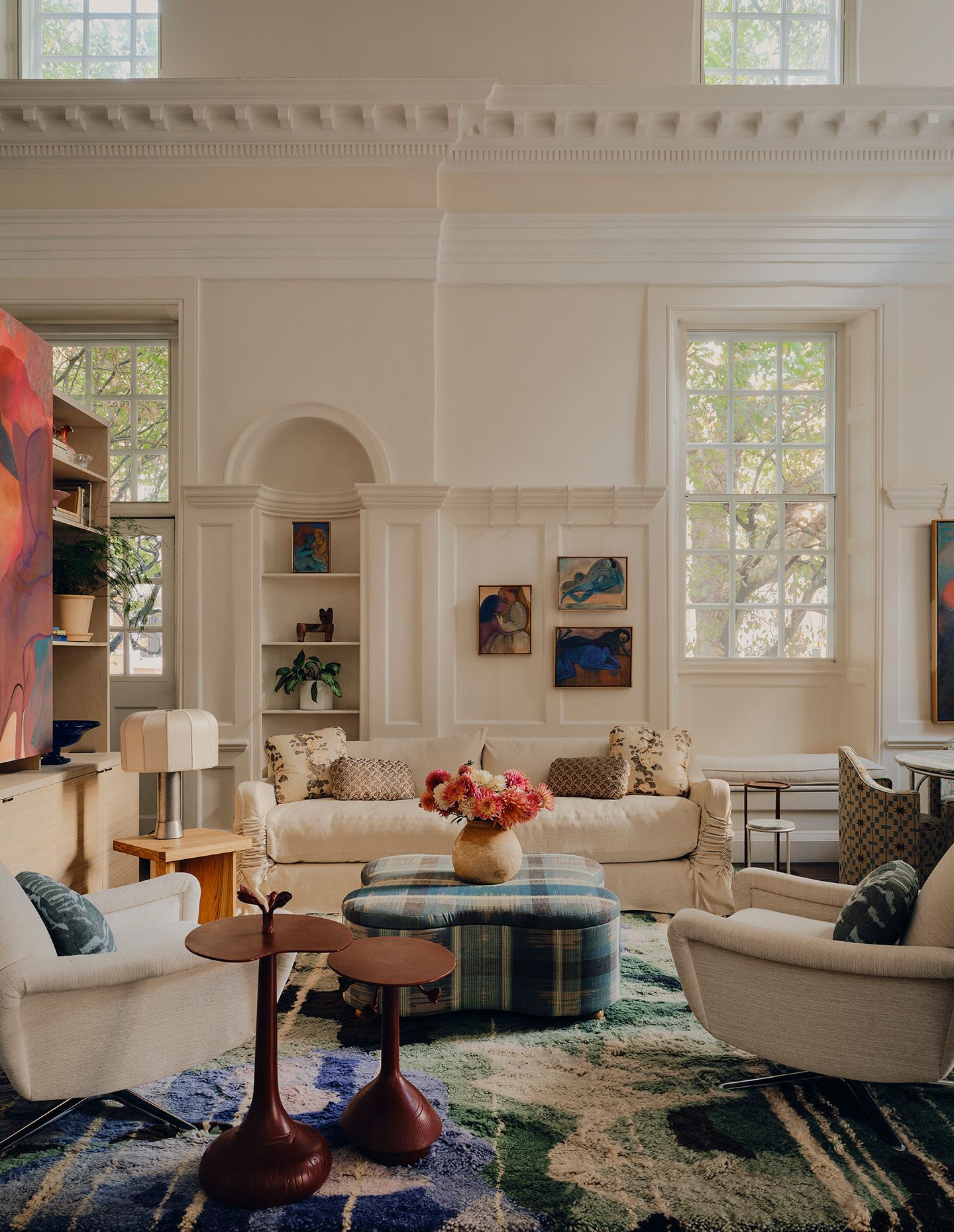
A woman sits with sovereign ease, a hand folded calmly in her lap, one leg slung over the other. She radiates a quiet heat, glowing orange like the embers of a fire, all full of latent energy, and with nothing to prove. Beside her sits another figure, painted in a liquid, chartreuse neon. She also emits her own light, a light that struggles to reach the third figure in the right hand of the scene. This figure is shadowy and diminutive with loose hair and a concentrated brow which makes her look eager to please, or to receive, but what exactly, we do not know.
Anna Ilsley’s painting, and the exhibition’s title - Host - conjures up ideas of holding or presiding over space for others. It also carries a sense of allowing something to grow inside it : connections and ideas, new life and new bodies, but also other things that might not always be comfortable ( - a virus, a parasite perhaps?) In any case there’s something about this painting that feels like a view of the inside: the bruised sunset palette reminiscent of a retinal afterimage imprinted on the backs of the eyelids, a fleeting image that has nevertheless made its way inside the body.
But back to this enigmatic trio. They are female figures but are clearly not ‘hostesses’, a term that stereotypically suggests a watchful, well-manicured femininity in service to the comfort and satisfaction of others. These ‘hosts’ rather have something else to offer the smaller figure, who by contrast seems like an initiate who hasn’t yet found her own light source, and the steady glow of self-possession that comes with age.
Or perhaps she is fading out of view, about to slip beneath the painted surface of the canvas. After all, the word ‘host’ lives inside another word: ‘ghost’, and they are here too. Ilsley’s canvases are haunted by traces of past fragments of images. Sometimes they are archetypal figures from art history, such as the beautiful maiden, decollete exposed; or the reclining nude odalisque - half quoted, half-imagined - from a renaissance painting. Sometimes they are paintings of saints, or carved figures from long-forgotten medieval fireplaces; sometimes they are trawled from the vast contemporary sprawl of advertising and reality tv.
They hum beneath the surface, residual indexes of other lives, unresolved feelings, past gazes, past ways of looking at, and containing women, as monsters or as muses. And alongside these hosts and ghosts, another character appears – one that also traditionally provokes fear. ‘Little Witch’ depicts two women, the contours of their faces finding refuge and connection in one another’s. Inspired by a dear friend of the artist, ‘witch’ is embraced as a welcome identity, one of endearment, a recognition of spirit and charisma, a name for one who has not been banished, is not cast out as ‘ugly’. Elsewhere in Fire Sprite, a coyly cool pink daimon (whose features were lifted from a medieval hearth) looks out at us knowingly, a supernatural guardian for the figure who cradles it and engulfs the surface area of the image.
One of the defining themes of this body of work is the relations between women - a vast and still under-explored, under-mythologised archive. Three riffs on sisterhood depict pairs of bodies compressed against one another, in an erotic intimacy of flesh and sympathy that resists being sexual. They ooze conspiratorial joy, shared wonder and each other’s shadows.
While our culture screams at women to stay looking superficially young (and uncertain of themselves), at great and painful expense, our ‘hosts’ and the roster of women populating these works seem exquisitely unbothered by having faces and bodies that do not conform to the strict, slick obedience required of contemporary beauty diktats and the drone-like dolls they have produced. And so, in opposition to the surface flatness of the ‘Instagram face’ and ‘thinspiration’, Ilsley revels in embodied volume: curves that swell unapologetically; hair standing tall in haystacks and beehives; skirts and sleeves that press against the edges of the picture frame as the women in her images literally take up space, expanding unapologetically.
The reclining nude odalisque, that ubiquitous motif from art history, and object of the male gaze makes a return here, through not as we know her. Detumescent, slumped like a deflated latex paddling pool, her complexion jaundiced and acidic Odalisque gives us the archetype of sensual, available femininity when it has been left out too long and begun to spoil, its fallacy as a projection of femininity exposed in the slow collapse of its own flesh. Yet she seems remarkably unbothered: if she is to decay, it will at least be on her own terms. Elsewhere the reclining nude returns more gleefully. In Movie Night two bulky odalisques lounge on their fronts, turning a playful, quizzical gaze back out of the picture. No longer laid out for looking, they have become the audience, seeing as subjects rather than lying as objects of a cultural gaze that would flatten them into taught and disciplined surfaces.
It's clear that painting, for Ilsley, is a generative, fertile space. Quickening, a vast, larger-than-life canvas, makes this palpable with its miasma of overlapping, hybrid animal-human figures and its tender, luminous palette. 'Quick' is an archaic word for living, and 'quickening' names the first perceptible flickers of movement inside the maternal body. Ilsley maps these fluttering sensations of growth and gestation as something at once resolutely animal and emotional, psychic: an inexplicable doubling, splitting and coagulation of forms and matter, feelings and histories. The uterine cavity here is not an empty space but a portal, and a host, like the canvas itself, to an abundance of possibilities and stories. What, these works seem to ask, can be hosted and held in painting, about that terrain where women's surfaces and their subterranean interiors meet?
Catherine McCormack