In Conversation With Anna Ilsley
The figures in Anna Ilsley’s paintings have a magical duality to them. Swelling, undulating, unapologetically assertive bodies spread and shimmer, as if dancing both behind and beyond the canvas. As Catherine McCormack writes in her introduction to Host, the body of work conceived for Sister, “After all, the word ‘host’ lives inside another word: ‘ghost’, and they are here too. Ilsley’s canvases are haunted by traces of past fragments of images.”
We discuss this in our conversation – which spans Renaissance literature, Love Island, witch trials and ancient gods and goddesses – digging beneath the surface of the binaries and contradictions that have plagued women throughout history. Ilsley’s body of work – in particular Host – explores that tension between who women are, and who they are asked to be. Where shortcuts are not just offered but expected, and discomfort is discounted at the expense of perfection, Ilsley’s practice offsets an aestheticised world that is constantly trying to optimise.

Can you start by telling us about the body of work you created for Sister. The exhibition is called Host. Where did that title emerge from and what questions, challenges and themes are you expressing on your canvases?
So much has piled into these paintings, most of which I made this year. Self Esteem at Glastonbury, Olivia Attwood’s ITV series The Price of Perfection, the concept of idle gossip, the witch trials and the ‘spooky’ reference they are often given by cultural institutions. The work seeks to embrace the beauty of imperfection in a culture where women to varying degrees learn that their beauty is their currency, agency and survival*. On my studio wall is written ‘resist streamlining, cool, fitting in’. Rather, they embrace love, tenderness, friendship, devotion.
The exhibition title, Host, is taken from one of the paintings in the show, and it immediately felt right to describe the whole body of work. The word ‘Host’ brings to mind notions of comfort and coming together in the home. It also asks, ‘what is a home?’, and what do we ‘house’ within our skin, our bodies? And then, of course, the word ‘host’ peels back the exterior; we can host a parasite, a transplant, a fetus… uplifting and unwelcome thoughts. There are multiple possibilities, which is the crucial part for me.
Where do you draw inspiration from? And how do you stay inspired?
A fair amount of looking and reading! Right now on my table is The Wax Child by Olga Ravn, Caliban and the Witch by Silvia Federici, The Trotula and Acts of Creation by Hettie Judah… I flit between them and find they inform one another a lot. I recently visited the V&A East Storehouse in Stratford as part of their ‘order an object’ scheme as I wanted to see those massive Panier court dresses, so huge that you had to walk through doorways sideways. The extremes of beauty standards and dress expected of women throughout history, whether that’s high end or mainstream, comes into the work too.
I’m also a sucker for Medieval and Renaissance art, especially love church wall paintings and stained glass, and well anything medieval, and I take a lot from music videos and reality TV too… I find the research enters back into the work somehow or other. I’m a frequent visitor to the National Gallery and love the late opening on a Friday. I draw from paintings I love, as well the ones I want to start an argument with (a lot of the time it’s both!). I like twisting the details as I draw, such as eye contact and shifting bodily autonomy.
And how does this end up translating onto the canvas?
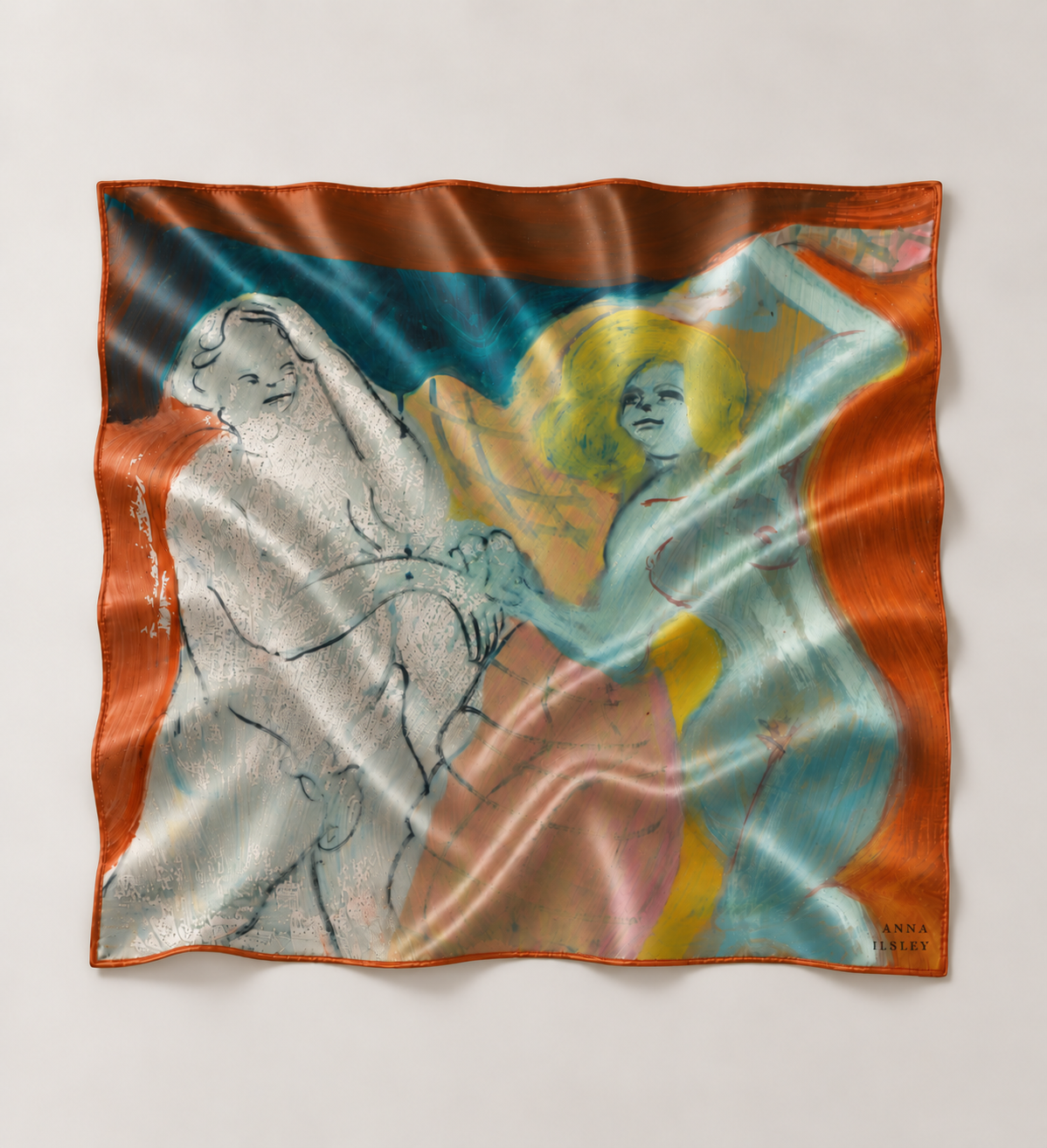
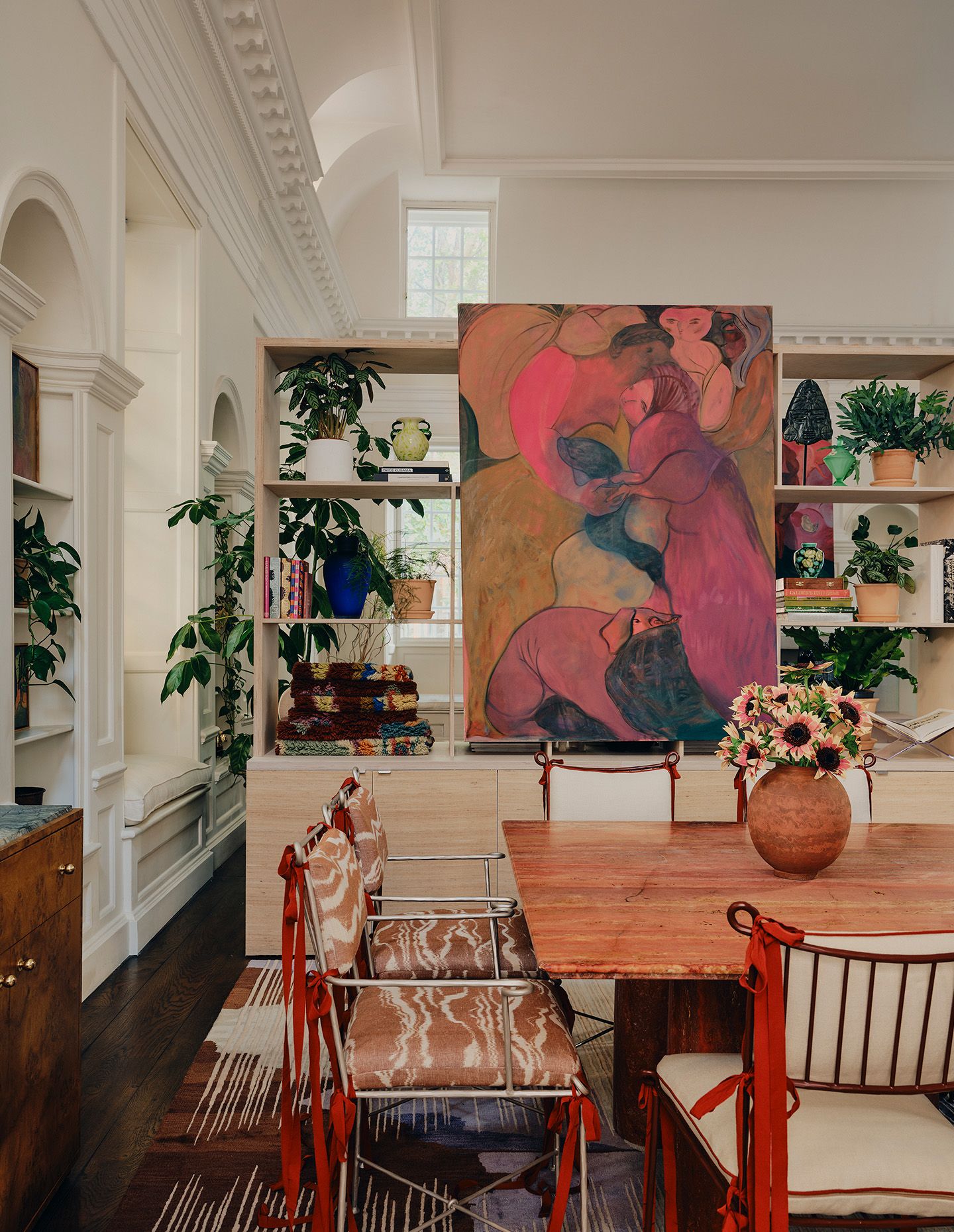
Those gallery drawings often become a starting point for the paintings. There is a drawing in this exhibition, Heretics, which I drew at the Courtauld from Cranach’s Adam and Eve there. It inspired the painting of the same name that we used for the silk scarf, (with all profits going to War Child). There's another painting in the exhibition called Big Mother, and that began with a huge book that my friend had found on Sienese Art. In it, there is a large arresting image of a female saint. I loved the way that she was depicted from head to toe, almost holding up the page. As if she were the literal support. And I was thinking about a painting and its format; how that structure can be both a framework that might support a figure, as well as a kind of constraint that restricts it. It became a metaphor for me that I’ve used again and again. So I had her in mind and I knew I wanted to use her in a painting.
But then at the same time I was watching a lot of Love Island. I loved all the laser-cut swimwear, kind of brushstroke-thin. I’d also recently had a baby and these Boohoo bikinis were like a kind of gleeful horror show to imagine putting on.
I think that, when painting, it’s almost like little characters pop up on your shoulder. They might say: “Try blue skin. Give her that Van Eyck horned hairdo in the portrait of his wife. That ferret-y sausage dog could be cradled there” That’s the sweet spot! So the saint/mother character in this swimwear evolved really quick, and then all other kinds of references started piling into that painting.
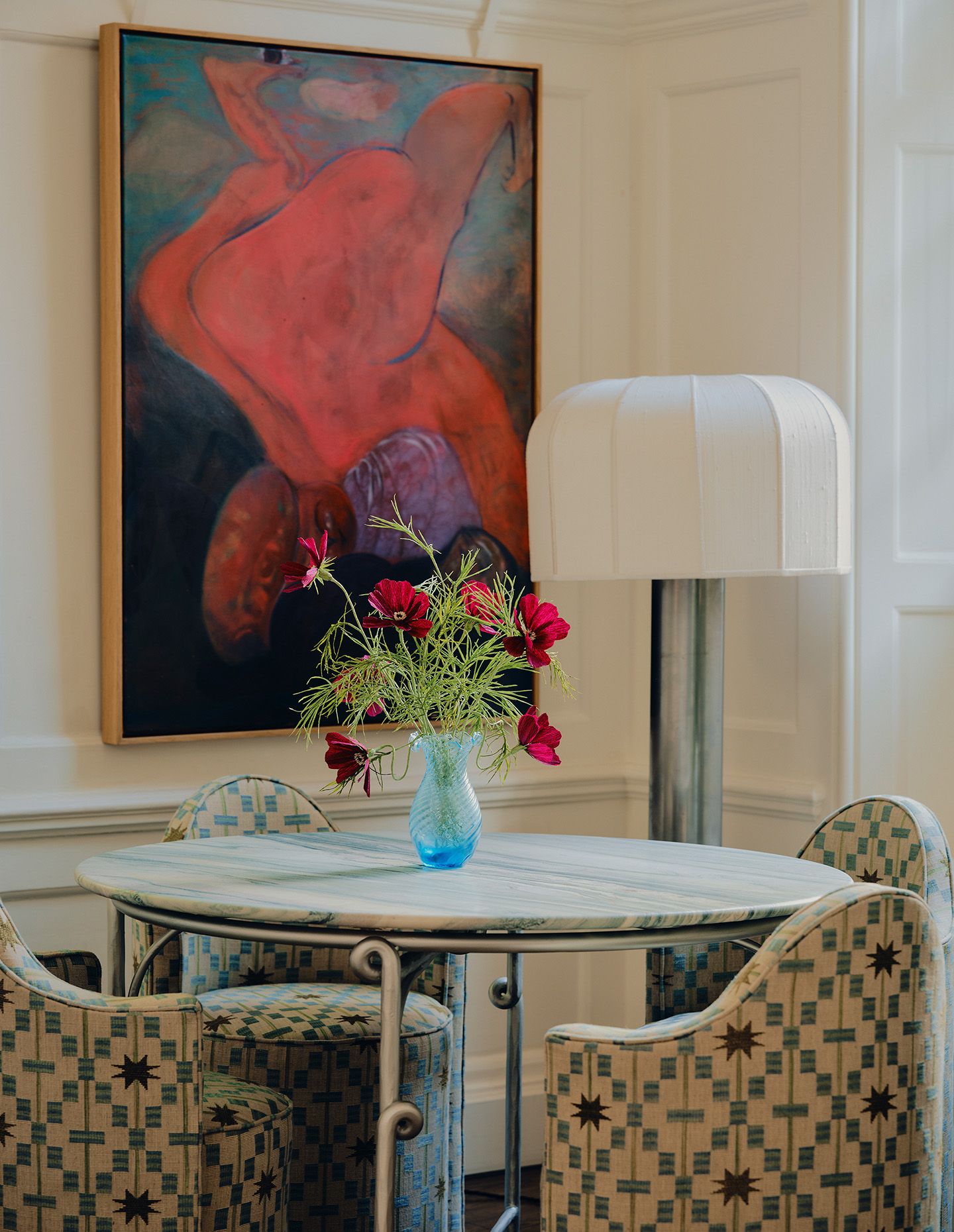
I love that you can have that conversational binary; the dichotomy of a Renaissance reference intersecting with a contemporary cultural touch point like Love Island. You can see the tension of these references in your work – there’s definitely a fertile aspect, and it often explores womanhood and women’s bodies. What drew you to this?
Initially it was a great history teacher at secondary school who taught us about the persecution of witches and the mark this made to this day. I always felt compelled to make sense of how the forces at large did that to a group of largely poor women and widows skilled in medicine, herbs and midwifery. I was also fortunate to spend 3 months in Athens at the British School where I researched the metamorphosis of divine women. All this feeds in when I’m painting: I think a lot about the way society has historically controlled, feared and revered the female body – particularly female sexuality – and how these contradictions still shape the way women move through the world.

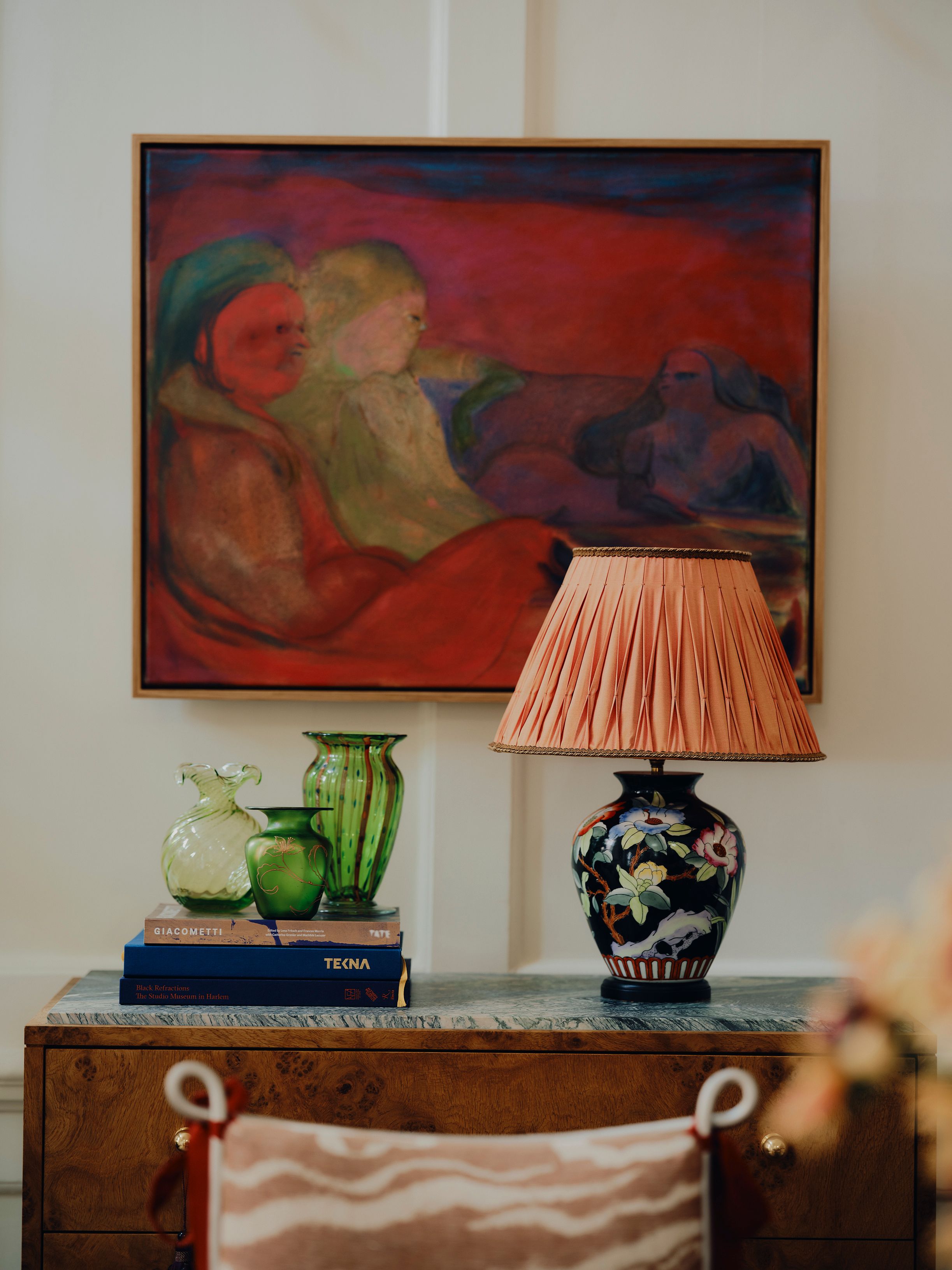
I can really see that in this body of work specifically – the swelling, undulating, expansive interior worlds of women. It feels like Host is a response to that attempt to confine as you mention, and fits in with what you were saying about the frame as both a support and a restriction.
Definitely. I am all about describing those interior worlds. When you look at the ancient religions such as Hinduism there are hundreds, even thousands of deities; we need that many characterisations in order to reflect the expanse of life, right? : the experience, the challenges we face, and the love that we feel. That's the kind of expression we need.
Going back to your question though and the attempt to confine, the term idle gossip we touched on before is worth coming back to. The word ‘gossip’ has been through a lot – it originally meant close friend: the kind you have the strongest bond with. Women gave birth with their ‘gossips’ but during the 16th century the word was demonised and it became associated with foolish babble and sin. At this time, women were forbidden to leave the home alone, their communication with one another policed. And this kind of poisonous erasure still exists in the world today. Many of the paintings - such as Sisterhood i-iii and Little Witch, were made in response to these kinds of restrictions placed on women’s lives and to counter this I load all the ferocious admiration and love for the women in my life - friends, my daughter, my mother; and channel it into the paintings. It’s a microscopic act but it’s something.
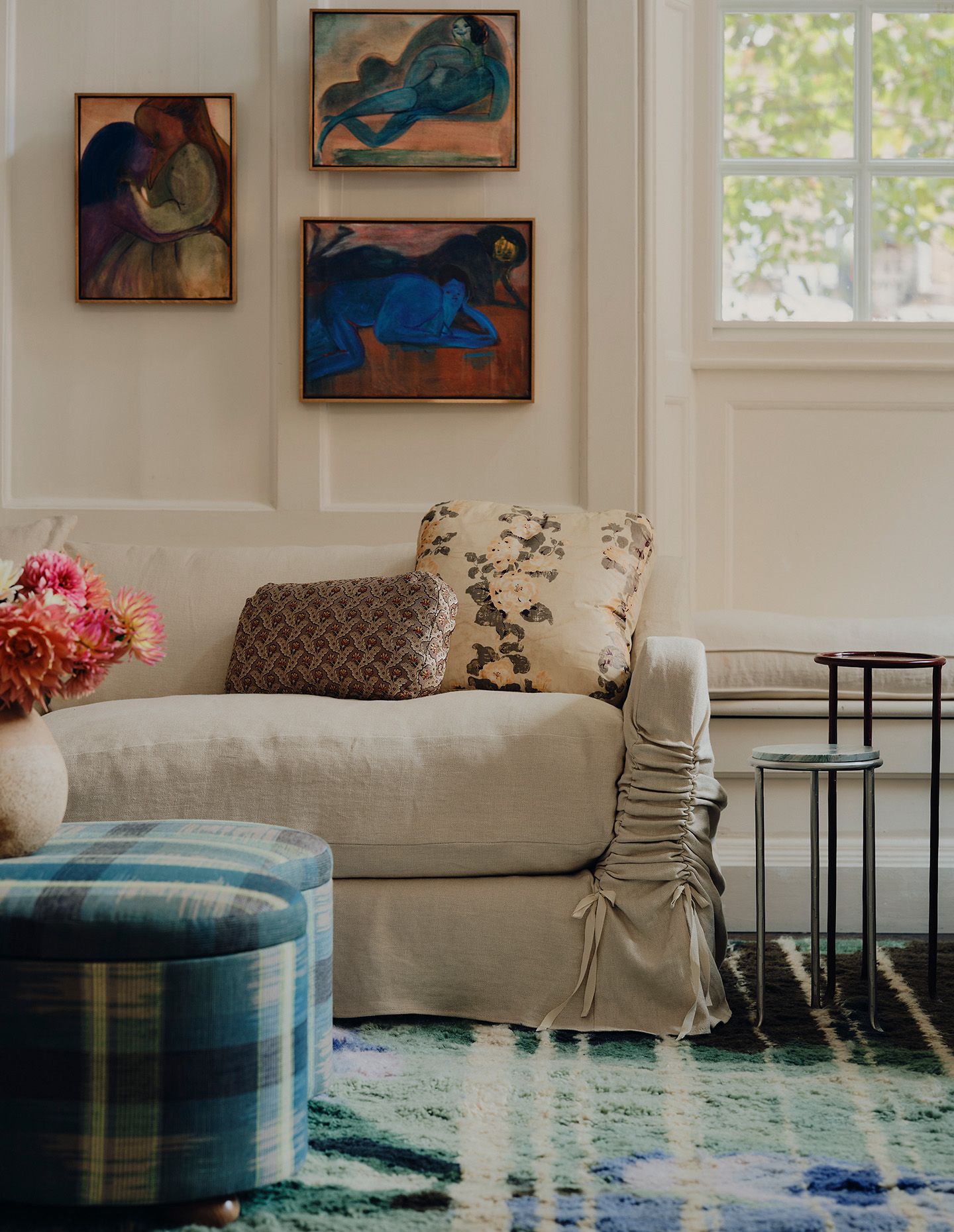
How do you land on a certain colour palette for a body of paintings? There’s obviously a thread that ties all your work together; Host feels very rich, unctuous and assertively feminine – does the palette come before the idea of what you’re going to paint or after?
I don’t organise my paints and make a palette, though there are certain dominant colours that recur through a series of paintings. With ‘Host’, I had in mind colours that ignite and warm. At the moment I have a lot of red figures popping up and that’s completely new. If it feels right in the moment that’s enough for me. Maybe it comes back to those characters that almost guide me as I work – whether it’s eradicating the purple or applying a skin of that unwanted sticky blue I found outside someone’s studio. And when the colours aren’t working, I have a technique born out of frustration which is to apply a very thin layer of turpsy paint, so that you can still see what's happening underneath, but the colours are all slightly altered under a kind of fog or veil of paint, through which you can still make out the ghosts of the figures in the surface below.
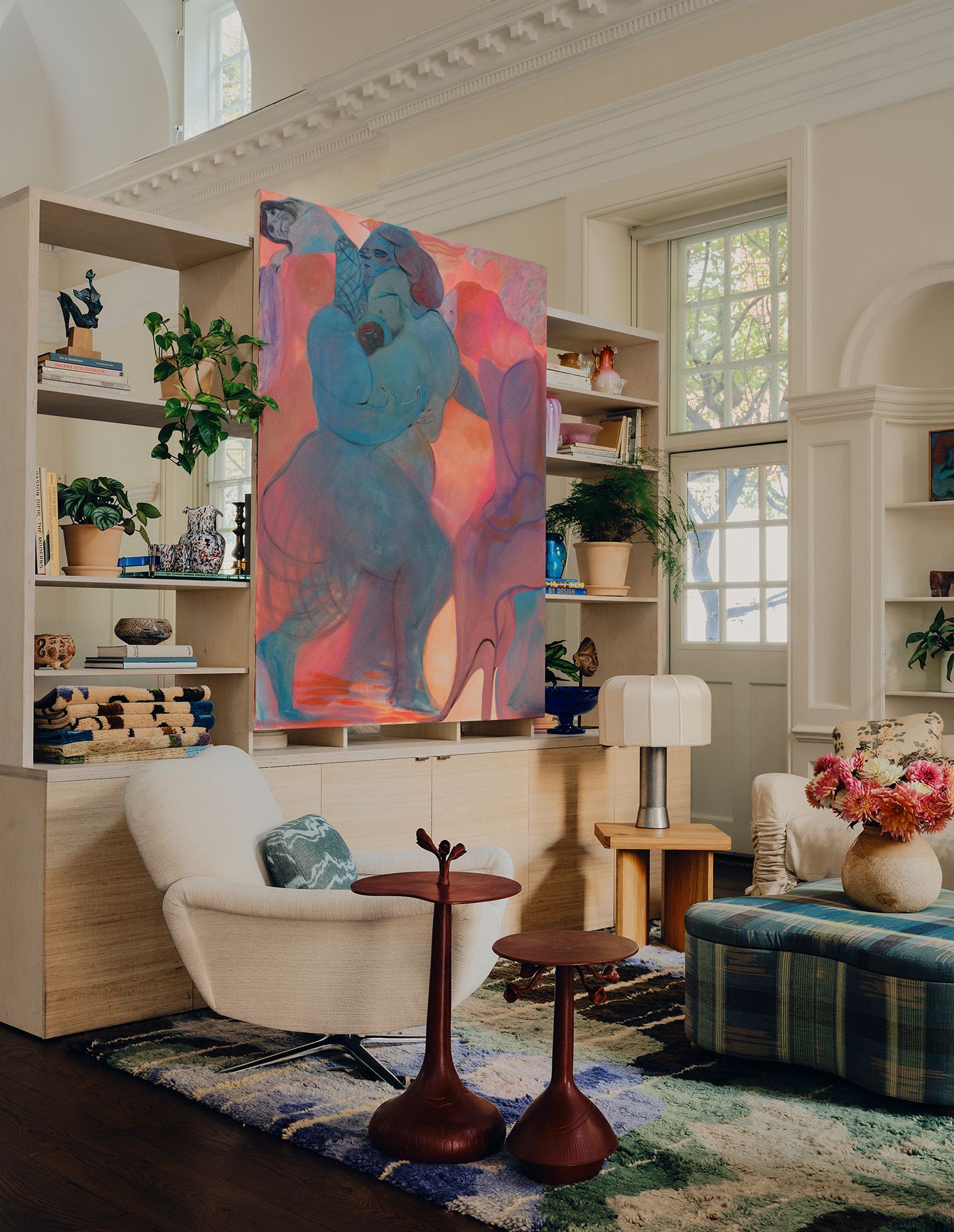
Going back further, when did you start painting and why?
This takes me straight to a feeling; a memory of walking to the bus stop, past my school where you could see the art room from the road. I remember looking up and I must have been 12 or 13 and seeing my painting through the window. And I felt like I was walking on air. It was very joyful; everything felt right. Getting in that headspace is the addictive part of painting.
And what’s so addictive about painting for you?
You never really know where you're going to end up, and you never know what is going to creep out of the surface of the paint. It’s an adventure. Now, I tend to paint around 15 to 20 paintings at a time – they evolve really slowly in my studio and change dramatically as I work. I don’t have a firm idea of what will happen next, and that’s the fun of it. There’s also a kind of creeping of information across the surfaces. Sometimes, just holding a paintbrush is like turning on a tap and imagery pours out, it's good, it's the best feeling.
How do you move past those more challenging moments where a painting – or the process – might not be doing what you hoped it would?
I think that artist's block or writers block or whatever block it is, is often telling you to change tack. Or have more fun with the work. When I'm painting or drawing, if the road that I've been treading for a while isn't really serving me anymore, I have learnt to turn around and try a different route. We have a million different ready-made ways of doing that – for example in the drawing world it might be automatic drawing or drawing with your eyes closed or disabling your process in some way or another in order to create a new one. Picking two colours you’d never place together and finding a way to make them hum. And I think that those blocks are actually what enable us to keep making work that pushes boundaries.
Words by Cat Sarsfield, photography by Dean Hearne